|
What are the barriers in the way of making a
disability claim?
CBC Radio One will broadcast a special Remembrance Day Call-in Show
Here is an Opportunity for you to share your experience with the
VAC Claims Process
Alex Bowers, Legion Magazine, Interviews Jim Hutton -
October 14 2026
CBC Journalist Marie-Isabelle Rochon on Military Cancers
- November 14 2025
CBC Finds VAC Gets it Wrong 90% of the Time
- June 18,
2025
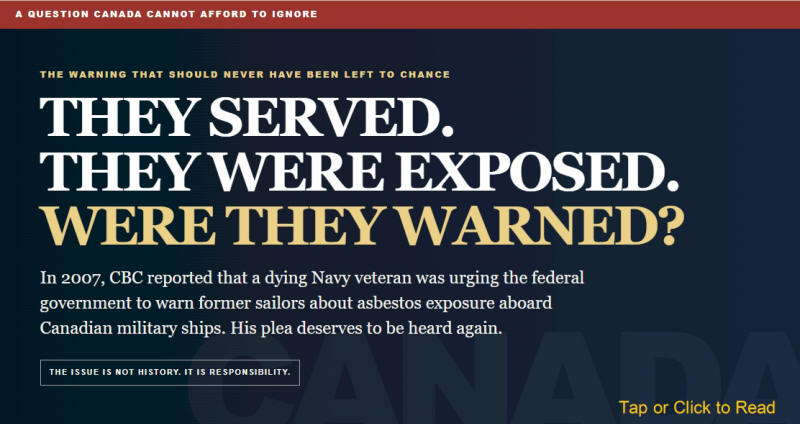
Research conducted by CBC Journalist
Marie-Isabelle Rochon
Disability claims for cancers
(article)
Veterans Affairs Canada - Cancer Claims
January 2015 to October 2025
Of 5,888 claims submitted,
VAC adjudicators denied 4,035 or
68.5%
Of the 4,035 that were denied, only 552 or 13.7% requested a VRAB Review
This means that 85.4% or 3,447 veterans just walked away when
their claim was denied
Veterans Review and Appeal Board - Cancer Reviews
January 2015 to October 2025
Of the 552 Reviews VRAB Panels conducted 266 or 48.2% were
approved.
|
|
Think about these stats if your claim is denied; ... but, if it is,
don't be disappointed since VAC denies almost 70% of all cancer claims |
A Pathway to Reducing
Wait-times
for Veterans
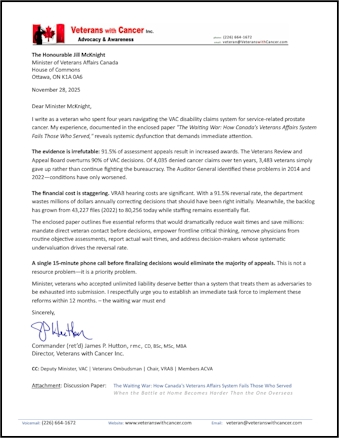
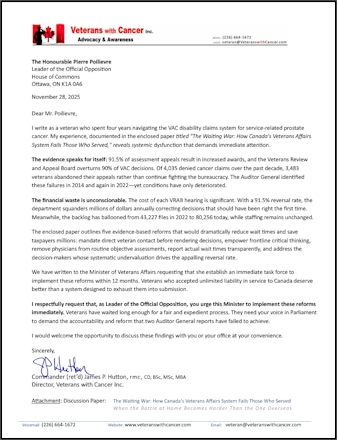
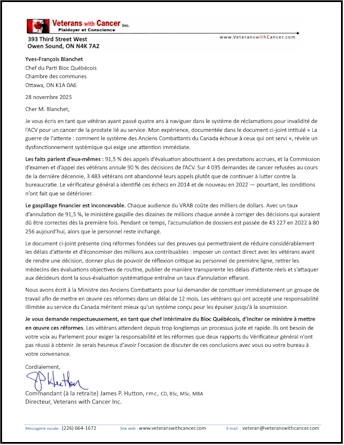
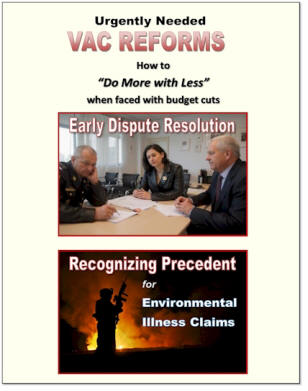 We sent out nine (9) personalized letters both by email and
Canada Post providing key players with two realizable reforms
that can dramaticaly reduce wait times for veterans despite the
massive budget cuts. (check
them out here)
VAC has failed to meet its own service standards
for disability benefit claims for over a decade, a fact documented by
the Auditor General in both 2014 and 2022. Caseloads have grown by 61%
since 2015. Veterans routinely wait three to five years for final
resolution.
Now, severe budget cuts have reduced the Bureau
of Pension Advocates — the only free, impartial legal service available
to veterans — by 44%, from 226 staff to 130. With 27,000 claims in the
existing backlog and 25,000 new files expected in 2026 alone, experts
warn that wait times could triple.
The Reforms
This paper proposes two
structural reforms that can dramatically reduce wait times and improve
outcomes — within existing budget constraints — built on five
foundational changes:
• Precedent Recognition for
Environmental Illness Claims • When VAC has previously
granted entitlement for a specific cancer arising from a specific
documented environmental exposure, all subsequent veterans presenting
the same diagnosis from the same exposure should receive automatic
entitlement. This eliminates the inequity of veterans with identical
circumstances receiving different outcomes based on the order in which
they filed, dramatically reduces adjudication caseload, and concentrates
scarce resources on genuinely novel cases.
• Early Dispute Resolution •
A small team of professionally trained facilitators,
reporting to
the VRAB, would be deployed to facilatate discussions
between the VAC decision-maker and the veteran. There are three possible
outcomes:
(1) confirm the original decision was fair;
(2) identify
specific additional evidence that would support a revised
decision; or
(3) agree that the case should proceed to a
VRAB Review. |
A directly analogous program implemented at the BC Public Service
Appeal Board resolved 70% of appeals without the need for adjudication.
Download this Paper - Doing More with Less
- March 2026
CBC Journalist Marie-Isabelle Rochon on Military Cancers
- November 14 2025
CBC Finds VAC Gets it Wrong 90% of the Time
- June 18,
2025
|